
EmpowerEd Weekend
A weekend learning experience where Michigan educators come together to deepen practice, share innovation, strengthen communities, and shape the future of education.
People Centered Pedagogy & Practice
Defy Gravity
Defy Gravity: Interrupting Adultification & Rebuilding Systems that Let Black Girls Fly is an interactive workshop that challenges educators to examine how adultification, coded language, and disproportionate discipline shape Black girls' daily experiences in schools.
Participants will engage in bias-interruption practice through real classroom scenarios, learning a concrete protocol for pausing, reframing, and responding more equitably in moments of tension. The session then shifts to structured planning time, where educators audit their classroom norms, discipline practices, and school policies to identify where Black girls may be unfairly burdened and where lift is needed. Participants will leave with specific adjustments to policies and practices, along with measurable action steps to implement in their classrooms or school systems.
Facilitator Information
Silver Moore
 Silver Moore is the Senior Director of Middle School Curriculum & Instruction at University Prep Schools in Detroit, where she works alongside instructional coaches, assistant principals, and school leaders to develop self-actualized, college- and career-ready students. Beyond her work in schools, she is the founder of Classroom Clapback, an education consulting platform that equips educators with culturally sustaining, social justice-oriented literacy resources to create classroom spaces that celebrate the genius of Black children. Silver is passionate about curriculum innovation, instructional equity, and transformative leadership and committed to reimagining education so that all students, especially Black youth, see themselves reflected in their learning experiences and have access to the tools they need to succeed.
The POWER of Classroom Management
Classroom management is often framed as control, compliance, or personality. This workshop reframes it as POWER—the power to protect instructional time, teacher energy, and student dignity through intentional systems.
Using the POWER framework (Procedures over personalities, Ownership, Warm–strict balance, Environment by design, Response not reaction), participants will engage in collaborative, hands-on work to diagnose real classroom challenges and design management systems that actually hold up in practice. The session prioritizes application, peer problem-solving, and guided design over presentation.
Participants will actively build a POWER-Based Classroom Management Blueprint they can implement immediately in their classroom or use to support others through coaching or leadership.
Facilitator Information
The Accommodation Lab
Too often, accommodations are viewed as a "checklist" for compliance rather than a bridge to equity. For many educators, the gap between reading an IEP and implementing it in a busy classroom feels insurmountable, leading to missed opportunities for student success and increased teacher burnout.
In this session, participants will move from theory to high-impact practice. Led by a multidisciplinary team, including special educators, an occupational therapist, and a former general educator, this workshop frames accommodations as a vital component of Universal Design for Learning (UDL). We will deconstruct the "why" behind neuroaffirming supports and provide a clear roadmap for the "how."
Attendees will spend time in a "Design Lab" environment. Using provided templates, tools, and collaboration from other educators, participants will choose a session work path that fits their role.
Participants will leave not just with knowledge, but with a ready-to-use Implementation Kit, including a customized accommodation tracker and a bank of Tier 1 strategies that can be deployed on Monday morning to support all learners.
Facilitator Information
DeDe Olthoff
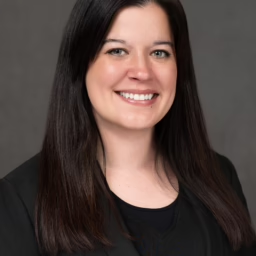 DeDe Olthoff is a Kentwood-based elementary special educator and an alumna of the TeachMichigan Aspiring Leaders cohort. An advocate for neuroaffirming practices, DeDe focuses on inclusive learning design and collaborative problem-solving. She specializes in creating tangible systems that help Michigan educators implement and track accommodations effectively, ensuring every student has a seat—and a voice—at the table.
Devon Baker
 Devon Baker is a neuroaffirming, strengths-based Occupational Therapist serving elementary students within Kentwood Public Schools. With a focus on sensory integration and equitable access, Devon specializes in identifying and leveraging the unique internal assets of every student. As a dedicated advocate for inclusive design, they partner with educators to create regulated, accessible environments where students can thrive on their own terms. Devon’s work is rooted in the belief that when we design for a student's strengths rather than their deficits, we unlock their full potential for participation and joy in the classroom.
Rebekah Hall
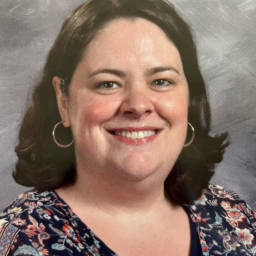 Rebekah Hall is an Elementary Resource Teacher in Kentwood, MI, known for her student advocacy and commitment to inclusive excellence. Rebekah excels at seeing the "whole child," quickly identifying the specific strengths that allow students to overcome barriers to learning. Her expertise lies in translating individual student needs into actionable classroom strategies that empower both the learner and the teacher. By fostering a culture of high expectations and tailored support, Rebekah ensures that inclusion is not just a placement, but a meaningful, successful experience for every student she serves.
Disruptions in a Schematic Play Lens
What if the behaviors we label as “disruptive” are actually expressions of unfinished developmental patterns?
In this interactive session, educators will explore student behavior through the lens of play schema theory: a framework rooted in early childhood research that explains how children (and adolescents) organize their learning through repeated patterns of movement, exploration, and interaction. Participants will examine common classroom disruptions (movement-seeking, object manipulation, avoidance, repetition, boundary-testing, etc.) and reinterpret them as potential schematic drives such as trajectory, enclosure, transformation, connection, or rotation.
Rather than asking, “How do we stop this behavior?” we will ask, “What developmental need might be trying to express itself?”
Through case studies, reflection prompts, and collaborative analysis, participants will:
- Identify common play schemas and their behavioral expressions in upper elementary and middle school settings
- Reframe challenging behaviors as instructional data rather than defiance
- Examine how bias and interpretation influence adult responses to behavior
- Explore proactive classroom structures that align with Universal Design for Learning (UDL) and restorative practices
- Develop practical strategies for designing learning environments that honor schematic drives while maintaining high expectations
By shifting from compliance-based responses to developmental understanding, educators will leave with tools to reduce reactive discipline, strengthen student-teacher relationships, and design classrooms that are both structured and responsive.
This session bridges instructional practice, equity, and behavioral systems by inviting educators to see behavior not as disruption but as communication.
Facilitator Information
Jessica Kruger
 Jessica Kruger is a middle school science teacher and Early Childhood Education professor based in Lansing, Michigan. With a background in Reggio Emilia–inspired leadership and over eight years as a center director, she brings a developmental lens to middle school classrooms and professional learning spaces. Jessica specializes in integrating play schema theory, CRPBIS, and Universal Design for Learning to reframe student behavior as communication rather than compliance. Passionate about equity, the Sustainable Development Goals, and student voice, she works to build classrooms and school cultures where curiosity, belonging, and big thinking thrive.
Designing For the 3%
What happens when we intentionally design classrooms for the students most often pushed to the margins? Designing for the 3% is a commitment to restructuring how we teach and lead so that Black girls and other historically excluded students experience learning as a space of power, belonging, and possibility.
This session moves beyond inspiration into systemic action. Participants will examine how instructional design, grading practices, discussion structures, and collaboration models either reinforce inequity or disrupt it. Together, we will explore concrete and scalable frameworks that shift classrooms from compliance driven environments to spaces rooted in joy, rigor, and identity affirming practice.
Drawing from mathematics education, educator pipelines, and global fellowship experiences, this session provides tools that translate across content areas. Attendees will leave with practice ready strategies to transform both classroom culture and the systems that shape it.
Designing for the 3% does not lower the bar. It redesigns the structure so more students can reach it.
Facilitator Information
Amaris Evans
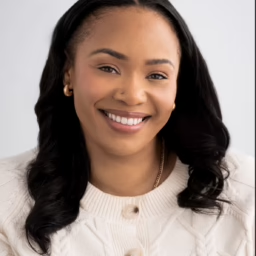 Amaris Evans is a Detroit native and mathematics educator and program leader on the South Side of Chicago with over 15 years of experience in K–12 education. She is the Founder and Executive Director of Black Girls Do Math Too, a nonprofit organization dedicated to building confidence, visibility, and success for Black girls in mathematics through tutoring, mentorship, leadership development, and joy-centered programming. In addition to leading her nonprofit, Amaris serves as a CTE Education Pathway Lead and Program Coordinator for the Lindblom Teacher Apprenticeship, where she supports more than 150 aspiring educators and 60 mentor teachers in developing strong, sustainable pipelines into the teaching profession. Her leadership focuses on designing student-centered systems, protecting and developing leaders of color, and bridging classroom excellence with long-term opportunity.
Amaris is a national speaker and NCTM Lead Presenter, where she shares practice-ready frameworks for curating authentic joy, rigor, and belonging in mathematics classrooms. She is also a Fulbright Teachers for Global Classrooms Fellow traveling to Senegal, expanding her global perspective on math education, identity, and cultural exchange.