
EmpowerEd Weekend
A weekend learning experience where Michigan educators come together to deepen practice, share innovation, strengthen communities, and shape the future of education.
Authentic & Impactful Leadership
Building Teams That Work
Healthy schools and organizations require healthy teams, yet many leaders are asked to guide adult teams without practical tools for addressing trust, accountability, and productive conflict.
This interactive workshop helps school leaders examine and strengthen the dynamics within their teams using Patrick Lencioni’s Five Dysfunctions of a Team framework paired with bell hooks’ concept of love as a leadership ethic rooted in care, commitment, trust, responsibility, knowledge, and respect.
Participants will engage in a structured Team Leadership Lab where they analyze real challenges from their own schools and diagnose where team dysfunction may be present. Through guided reflection, a team culture diagnostic, and collaborative planning, participants will identify patterns that may be limiting their team’s effectiveness and design leadership strategies to move their teams toward stronger trust, accountability, and shared ownership of outcomes.
Participants will also engage in a guided trust building activity that models how leaders can begin creating vulnerability and openness within adult teams. This activity provides a practical structure participants can adapt and use with their own teams to begin strengthening trust.
Throughout the session participants will assess, reflect, practice, and apply strategies that support healthier team culture.
Facilitator Information
Andrea Black Evans
 Andrea Black Evans is an equity centered leader, strategist, and community builder committed to fostering transformative learning environments for leaders. She serves as the Executive Director of Surge Academy, where she cultivates an intentional organizational presence across six cities, Washington DC, Philadelphia, Detroit, Las Vegas, Indianapolis, and Kansas City, ensuring Surge Academy’s vision and impact remain rooted in excellence, authenticity, and connectedness.
Andrea is also the founder of The Lantern - Wayfinding Solutions, a leadership and strategy practice that helps individuals and organizations navigate complexity, strengthen team culture, and lead with clarity and purpose.
Before leading Surge Academy, Andrea began her career as a Teach For America corps member in Atlanta Public Schools and later served as a principal in Chicago Public Schools, where she led the transformation of an underperforming school into one in Good Standing. Under her leadership, the school achieved Level 1 status and secured more than one million dollars in grant funding to improve the campus and strengthen its instructional culture.
Andrea holds a Master of Education from Harvard University and a Bachelor of Arts from Fisk University. A proud Chicago native and first generation college graduate, she is deeply committed to pouring into others and creating spaces where leaders thrive. She lives and is anchored by the words of Ella Baker: “Give light and people will find the way.”
Leading Through Resistance
Across the nation, initiatives rarely stall because of poor vision. They stall because pushback is misunderstood, authority is unclear, and communication breaks down across roles. When resistance is misdiagnosed, even strong strategies lose traction.
This session is a collaborative design lab where participants bring a real leadership or resistance challenge from their classroom, school, district, or policy context and actively move it forward. Rather than a presentation, the experience centers on educator voice, structured peer collaboration, and disciplined problem-solving.
Participants will:
- Diagnose resistance across emotional, structural, and strategic dimensions
- Clarify authority, decision ownership, and role alignment
- Identify communication breakdown points
- Draft a courageous conversation plan tailored to their real context
- Develop a 30-day implementation strategy
This session is dedicated to guided application. Participants will complete a structured resistance diagnostic, map stakeholder alignment, draft a conversation strategy, and leave with a concrete action plan ready for immediate implementation to transform resistance into forward momentum.
This session reflects the realities of education, including mandate fatigue, initiative overload, coalition leadership and the complexity of aligning stakeholders across classroom, school and system levels. Participants leave not just with insight, but with tools that help turn pushback into measurable progress.
Facilitator Information
Dr. Jermaine Wilson
 Dr. Jermaine Wilson is the Founder and CEO of Pivot Path Strategic Solutions and an Executive Leadership Coach dedicated to helping leaders design systems that create sustainable impact. He also serves as an Assistant Superintendent of Equity and Student Services, where he leads district-wide strategy focused on student dignity, professional learning, and systems coherence.
With a Ph. D. in Leadership and Policy Studies in Education, Dr. Wilson brings a disciplined, systems-level approach to leadership transformation. He partners with superintendents, executive teams, and education leaders across the country to strengthen strategic alignment, clarify authority, and cultivate high-performing leadership cultures capable of navigating complex change.
Through Pivot Path Strategic Solutions, he designs leadership cohorts, executive coaching engagements, and collaborative learning experiences that move leaders from reactive problem-solving to intentional architecture. His work integrates strategic clarity, emotional intelligence, and courageous decision-making to ensure initiatives move beyond intention to measurable implementation.
Dr. Wilson’s mission is to equip bold leaders with the clarity, courage, and structural discipline required to lead what’s next.
Kareeme D. Hawkins
 Kareeme D. Hawkins is a Purpose Coach, Social-Emotional Learning expert, and National Director of Customer Success at RethinkEd, where she leads national strategy supporting hundreds of school districts focused on retention, growth, and measurable student impact.
With over a decade of experience in public education as a teacher, counselor, and district leader, Kareeme brings deep insight into the realities educators face every day. She partners cross-functionally with executive teams to align strategy, execution, and outcomes, ensuring that initiatives are not only implemented but internalized by the adults responsible for sustaining them.
Through her work with Pivot Path Strategic Solutions, Kareeme co-designs collaborative learning experiences that strengthen emotional intelligence, manage resistance, and build psychologically safe, purpose-driven cultures. Her facilitation blends data-informed strategy with human-centered leadership, helping educators navigate change with clarity and confidence.
Kareeme’s mission is to help leaders and educators thrive so that every learner has the opportunity to succeed within systems built for impact.
Lead Self First
Research from The Wallace Foundation¹ makes it clear that strong teams begin with strong leadership. In fact, it is second only to classroom instruction among school-based factors that impact student learning. Leaders don’t just manage buildings; they shape the conditions where adults can do their best work, where goals are met, and where students can succeed.
Wallace’s findings² reinforce a simple but important truth: how leaders show up matters just as much as what they do. Schools improve when leaders build trust, stay focused on instruction, provide consistent support, develop their people, and create clarity. Those results are closely tied to a leader’s emotional intelligence, especially self-awareness.
Psychologist Daniel Goleman, known for his work on emotional intelligence, explains it this way: “If your emotional abilities aren't in hand, if you don't have self-awareness, if you are not able to manage your distressing emotions, if you can't have empathy and have effective relationships, then no matter how smart you are, you are not going to get very far”.³ Leaders who understand their own triggers, manage emotions under pressure, and respond thoughtfully instead of reacting impulsively are far more likely to build strong teams and healthy cultures.
In today’s schools, leaders are balancing academic expectations with the very real human needs of staff and, far too often, the basic needs of students. Self-aware leaders are better equipped to manage resistance, repair strained relationships, remain calm and consistent with constituents, and keep staff morale steady during challenging times. That steadiness builds a stronger school culture.
In this session, participants will not simply learn about these ideas; they will apply them. They will reflect on how they show up as current or aspiring leaders and identify patterns that either strengthen or strain their teams and colleagues. Participants will examine a current challenge and connect it directly to specific leadership behaviors. Each person will leave with one clear, intentional leadership move they are prepared to implement immediately.
Emotional intelligence isn’t a “soft skill.” It’s a leadership skill. When leaders lead themselves well, they create the kind of school environment where adults stay, and students thrive.
Facilitator Information
Brenda Belcher
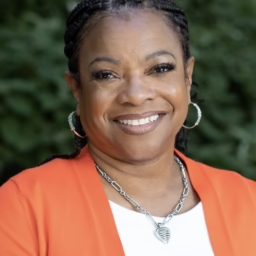 Brenda Belcher is an Education Consultant, Leadership and Executive Coach, and former district administrator with more than two decades of experience in education. Over the course of her career, she has served as a teacher, assistant principal, principal, and assistant superintendent, leading system-level work focused on student achievement, career and technical education, and leadership development.
As the owner of her own consulting practice, Brenda partners with school districts and organizations across Michigan to strengthen leadership capacity, build effective teams, and design high-quality career pathways. She currently coaches with Teach Michigan and collaborates with superintendents, principals, postsecondary institutions, and industry partners to align schools with real-world opportunities for students.
Brenda earned her Associate Certified Coach (ACC) credential through the International Coaching Federation and brings a disciplined, results-oriented coaching approach grounded in reflection, accountability, and practical action. She is passionate about helping leaders clarify their vision, strengthen their confidence, and build systems that produce measurable impact for students.
Born and raised in Detroit, Brenda remains deeply committed to expanding opportunity and excellence in education, one leader and one team at a time.
LaToyia Webb
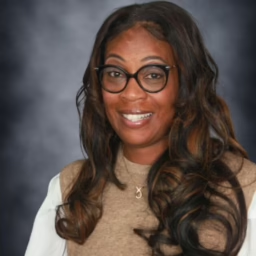 LaToyia Webb earned her Bachelor’s degree in Special Education from Eastern Michigan University and her Master’s degree in Educational Leadership from Wayne State University, holding certifications in Special Education and K–12 Administration.
With 19 years of service to Detroit Public Schools Community District, LaToyia began her career as a Special Education teacher supporting students in the Emotionally Impaired and Resource Room programs, where she spent many fulfilling years advocating for and empowering diverse learners. For the past 11 years, she has served in leadership roles, and is currently serving as principal for a K-12 Campus.
She leads with compassion, integrity, and a people-first mindset. She believes in treating others with respect and modeling the expectations she sets for her school community. Her commitment is rooted in ensuring that every student in DPSCD experiences academic achievement, social growth, and emotional well-being in an environment that fully supports high-quality teaching and learning.
As a Sitting Leaders alum, LaToyia often shares that she truly loves her work — inspired daily by her students, supported by her staff, and strengthened through meaningful partnerships with parents and the broader community.